top of page


INDEPENDENTLY TESTED
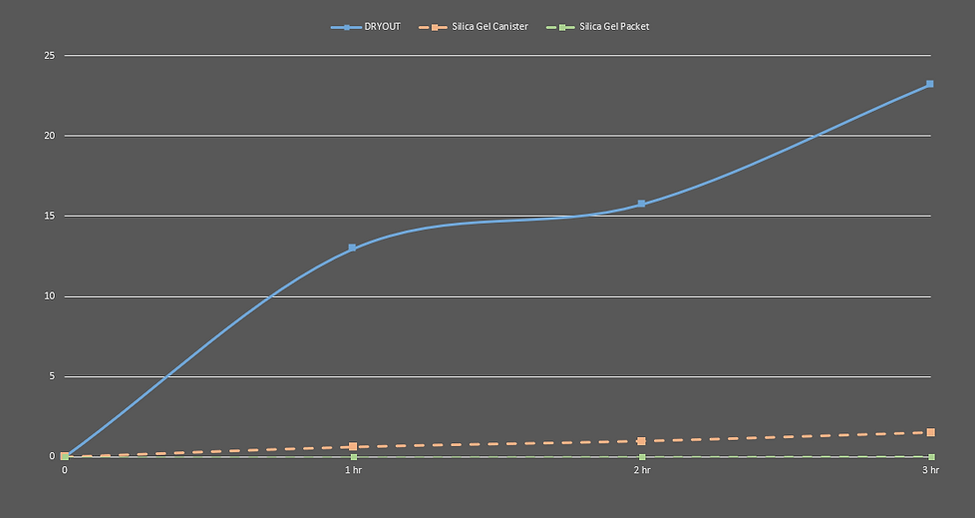
23 grams in three hours.
A 6" x 12" DRYOUT panel absorbed 23.2 grams of water in three hours under controlled laboratory testing at a third party lab.
DRYOUT PANEL - 3 HR
23.31 g
MEASURED
SILICA GEL CANISTER - 3 HR
1.51 g
MEASURED
SILICA GEL PACKET - 3 HR
0.0067 g
MEASURED
.png)
Is 23 grams a lot?
0.25-0.5 g
Smartphone
ESTIMATED
0.5-1 g
Optic, camera, drone controller
ESTIMATED
1.5-3 g
Long gun
ESTIMATED
23.2 g
Absorbed in 3 hours
MEASURED
Moisture load figures are directional estimates and very by device and atmosphere. These results measure material moisture uptake under controlled laboratory conditions - they do not represent a guaranteed device-drying time or recovery outcome, and do not imply a rescue capacity for any number of devices.
THE FUNDAMENTAL DIFFERENCE
Absorption starts after moisture is pulled away.
A material can only absorb moisture that reaches it.
Smartphone
Waits for moisture to migrate through the surrounding air.

TRADITIONAL PASSIVE DESICCANT
DRYOUT ACTIVE MOISTURE PULL

Smartphone
Actively pulls moisture away from nearby hard goods.
Storing moisture is not the first challenge. Pulling it away from the gear is.
THREE DIMENSIONS OF PERFORMANCE
Performance is more than capacity.
PULL
Pulls moisture away from gear
The first challenge is not absorbing moisture - it is pulling it away from the equipment. DRYOUT pulls moisture from the surfaces and surrounding spaces of hard goods.
TRAP
Absorbs and holds it
Once pulled away, moisture moves rapidly through the outer layer and into the absorbent core, where it is retained until the panel is reset.
RELEASE
Resets for repeated use
Sunlight, direct heat, or forced airflow releases trapped moisture and restores capacity for repeated operational cycles.
MOISTURE PULL
The ability to pull moisture away from nearby hard goods.
MOISTURE UPTAKE
How quickly moisture enters and moves through the material once pulled away.
MOISTURE CAPACITY
How much moisture the material retains before a reset is required.
WHY SPEED MATTERS
Moisture damage does not wait.
Residual moisture remains after visible water disappears. The longer it stays in contact with sensitive components, the more opportunity it has to contribute to fogging, corrosion, oxidation, and electrical failure.
DRYOUT panel
12.97 g
Silica gel canister
0.62 g
Silica gel packet
not measurable
Grams absorbed in the first hour under the stated test conditions. The tested silica gel packet registered no measurable uptake at one hour. Comparison reflects material performance under controlled conditions; actual device recovery depends on exposure severity, construction, contaminants, temperature, enclosure design, and how quickly recovery begins.
PERFORMANCE IN CONTEXT
Every technology has a job.
Most of these work well at the job they were built for. None of them were built for this one.
PASSIVE
Silica gel canister
Useful for enclosed storage such as safes, cases, and cabinets. Larger capacity than a packet, but depends on moisture reaching the canister through the air.
BEST USE
Humidity control in enclosed storage
PASSIVE
Silica gel packet
Proven for packaging and shipping. Compact, inexpensive, and effective at controlling ambient humidity in a sealed environment. Low tested capacity in packet form
BEST USE
Sealed packaging and shipping
POWERED
Plug-in dehumidifier
Effective at conditioning the air inside a safe. Requires power and stays put — it conditions the environment rather than travelling with the gear.
BEST USE
Powered humidity management in a safe or cabinet
HOUSEHOLD REMEDY
Rice
Not engineered for electronics. Minimal moisture uptake, not reusable, and can introduce particles into ports and openings. Apple's guidance on rice
BEST USE
Food
ACTIVE
DRYOUT
Engineered to pull moisture from hard goods. High tested uptake, resettable, and requires no electricity in operation. Supports post-exposure recovery and everyday moisture management.
BEST USE
Carry, storage, protection, and recovery for hard goods
Apple advises against placing an iPhone in a bag of rice, noting that small particles could damage the device. Read Apple's guidance.
PERFORMANCE IN CONTEXT
Recovery after exposure.
Management between incidents.
Moisture is not limited to spills and submersion. It arrives during normal use — and DRYOUT works in the environments where hard goods are carried, stored, and used.
AMBIENT
Humidity
THERMAL
Condensation
WEATHER
Rain
CONTACT
Sweat
COASTAL
Marine air
CYCLING
Temperature change
SUNLIGHT
Direct exposure
Within the approved temperature range
DIRECT HEAT
FORCED AIRFLOW
Air must be warm or dry. Cool, humid airflow may not fully reset the panel.
PARTNERSHIP
Built for a different job.
DRYOUT pulls moisture from the gear people depend on, traps it, and releases it so DRYOUT can be used again.
Products engineered with DRYOUT technology are co-engineered with your team, built to your specifications, and carry your brand.
DRYOUT partners with innovative brands, OEMs, government agencies, and defense suppliers to design, develop, and produce their next-generation storage and carry products, such as cases, bags, and packs, engineered with DRYOUT technology.


CONCEPT
DESIGN
DEVELOPMENT
PRODUCTION
LAUNCH
TESTING TRANSPARENCY
Unless otherwise stated, performance comparisons on this page reflect a 6″×12″ DRYOUT panel — approximately the area required for a tablet application — under controlled laboratory conditions over a three-hour evaluation period, with moisture uptake measured in grams. Independent testing performed by the Department of Chemical Engineering and Department of Materials Science Engineering at the University of Utah. DRYOUT is solely responsible for all product claims. Results compare material performance under controlled conditions and do not guarantee the recovery of any particular device.
Results can vary based on various factors, including:
- Exposure type and severity
- Amount and location of residual moisture
- Equipment construction and enclosure design
- Temperature, humidity, and contaminants
- Product size and configuration
- Time between exposure and recover
bottom of page